
The safest way to display playing cards is in a closed, UV-filtering case or on a shelf out of direct sunlight, with your display rotated every few months so no deck takes all the light. Pick the display that fits how you collect: single-deck cases for your best decks, shelves for a wall of tucks, modular setups that can grow as you add decks, and brick or set displays for series.
Shopping for someone? See our best playing card gifts for Christmas 2026.
This guide is about the fun part: getting your decks out where you can see them. If you're packing away the rest of your collection, our guide to storing playing cards covers humidity, heat, bins and long-term storage. Here, we'll stick to display.
Why display needs a plan
A tuck box is printed paper, and paper doesn't forgive light. The Northeast Document Conservation Center (NEDCC), which advises libraries and museums, puts it bluntly: fading from light exposure is "cumulative and irreversible." A tuck that fades on your shelf won't recover when you put it back in a drawer.
Museums handle this with a few simple habits, and they translate well to a deck shelf at home:
- Keep light low. Sunlight is the worst offender, because it's intense and high in UV.
- Filter UV. Choose UV-filtering acrylic or glass, and don't assume a clear case blocks UV unless it says so.
- Enclose what you can. A closed case keeps out dust, fingers and the occasional curious cat.
- Don't display anything permanently. Rotate, so the same decks aren't always in the light.
None of this means hiding your collection. It just means choosing where and how it sits.
Types of playing card display cases
Single-deck acrylic cases
A clear box sized for one deck is the classic way to show off a showpiece deck, like a limited edition, a numbered deck or a vintage pack. It keeps dust and handling off the tuck, and you can still see every side. These look great lined up on a shelf or desk, and they're the easiest way to protect the decks people always want to pick up.
Multi-deck cases
Cases that hold a row or grid of decks are perfect for a series, like every colorway of one design or a full run of a publisher's releases. A single front panel makes it easy to see the whole set at once. Look for one with dividers or a snug slot for each deck, so the tucks stand straight and don't lean on each other.
UV-filtering cases
Any case can be a UV-filtering case if the acrylic or glass is rated for it. NEDCC notes that some acrylics and most types of glass filter little or no UV, so this is a spec you need to check rather than assume. When choosing UV glazing, NEDCC advises checking that its UV-filtering capacity is greater than 90%. That's a good benchmark for a deck case too. If a listing doesn't mention UV at all, treat it as unfiltered.
Wall shelves and ledges
Shallow ledges or shelves made for small items turn a wall into a deck gallery. Face-out shelves are the most fun way to display a large collection, because you see every tuck front at once. Hang them on a wall that doesn't get direct sun, and keep them away from heaters and vents.
Brick boxes and set displays
A brick is a sealed box of 12 decks, and many collectors display the brick itself. A sealed brick or a boxed set can sit on a shelf on its own, or in a larger case. Keep the outer box clean and intact, since it's often part of what makes the set collectible.
Shadow boxes and frames for single cards
Some collectors frame a single standout card, like an ace of spades, a joker or an uncut sheet. This works best for extras, spare cards or reproduction sheets rather than cards from a complete deck. Use UV-filtering glazing, and hang the frame somewhere that never gets direct sun.
Modular, 3D-printable displays
Collections only get bigger, and a lot of us have watched a tidy shelf turn into a pile. Click, a Kickstarter project from CREO in Madrid, is a modular, 3D-printable display system designed to grow with a playing card collection.
You can download the STL files and print modules yourself, or get units CREO prints and assembles. Modules come in sizes from 2 to 16 slots and connect so you can start smaller and add on later. A typical physical display is two 12-slot modules (24 decks) with magnets already built in; a 16-slot middle module clicks between them and takes that up to 40. Decks sit in push-to-release slots, and there's an optional secret compartment plus a small top display for a few favorites at the front.
As of 10:18 AM America/New_York on Tuesday, November 24, 2026, the campaign had raised €1,511 toward a €2,000 goal (about 76%), with 26 backers. It launched on November 18 and is scheduled to end at 11:00 AM America/New_York on Thursday, December 17, 2026. Those totals change quickly, so check the live Click campaign on Kickstarter for the current figure.
A modular display is still an open shelf. Keep it out of direct sun, rotate what sits up front, and use a closed, UV-filtering case for the decks you care about most.
What to look for when choosing a display case
Before you pick a case, run through this checklist.
- Fit. Measure one of your tucks before you choose. Most custom decks are poker size, but tucks vary in depth, and some decks come in bigger boxes, two-piece boxes or wooden cases. A good case is snug, not tight. You should be able to lift the deck out without scraping the tuck or tearing the cellophane.
- UV filtering. Look for a stated UV-filtering or UV-resistant rating. If it isn't stated, assume there's none.
- A closed front or lid. A sealed or lidded case keeps out dust much better than an open stand.
- Materials. NEDCC warns that some woods, sealants, paints, adhesives and fabrics give off gases that build up in a sealed case and damage paper over time. Clear acrylic and glass are good choices. If you love the look of a wood display, let fresh paint or finish cure fully before closing decks inside.
- A stable base. A deck that tips over in its case is a dented corner waiting to happen.
- Room to grow. Collections only get bigger. A modular case or a shelf with extra space saves you from rearranging every month. That's the idea behind systems like Click, above.
How to arrange your display
The best displays tell a story. A few ideas that work well:
- By series or colorway. Line up every edition of one design so the differences pop.
- By publisher or artist. Give a favorite creator their own shelf.
- By theme. Cats, horror, space, vintage reproductions: themed shelves are fun to put together and fun to look at.
- By year. A timeline shelf shows how your collection has grown.
- A "rotation" shelf. Keep one spot for your current favorite, or a new arrival, and swap it out often.
If you're displaying decks that matter for their condition, it's worth reading our playing card grading guide first. It explains what collectors look for, from crisp corners to intact seals, so you know what to protect. Our finishes and card stocks guide is handy too, especially for foiled and gilded decks that catch the light.
Lighting your display
Good light makes decks look their best, and the right kind does it without harming them.
- Skip the sunny window. NEDCC says sunlight isn't recommended as a light source because it causes extensive fading.
- LEDs are the friendliest choice. NEDCC notes that LEDs don't emit UV or infrared radiation. If you put LED strips inside a case, make sure they're rated for use in an enclosed space.
- Keep light levels low. For reference, NEDCC says most collection materials can be displayed for three to four months at 50 to 150 lux without fading, and 50 lux is about the lighting of a living room in the evening.
- Keep hot bulbs away. Incandescent and halogen bulbs give off heat, so keep them well away from your decks and never inside a case.
If you photograph your display for social media or your PlayingCardHub profile, our guide to photographing playing cards has tips for avoiding glare on acrylic and cellophane.
A quick storage reminder
Not everything needs to be out at once. For the decks that aren't on display, our storage guide walks through the five enemies of a collection (humidity, sunlight, heat, pressure and pests), how to store sealed and opened decks, and how to set up bins for long-term storage. Rotating decks between storage and display is one of the easiest ways to protect both.
Holiday gift ideas for playing card collectors
Display pieces make great gifts, because most collectors have more decks than places to show them. A few ideas:
- A single-deck acrylic case for the collector's best deck. It's an easy gift to get right, since poker-size decks are the norm.
- A UV-filtering multi-deck case for someone who collects a series.
- A set of face-out wall ledges for a collector whose decks are stacked in a drawer.
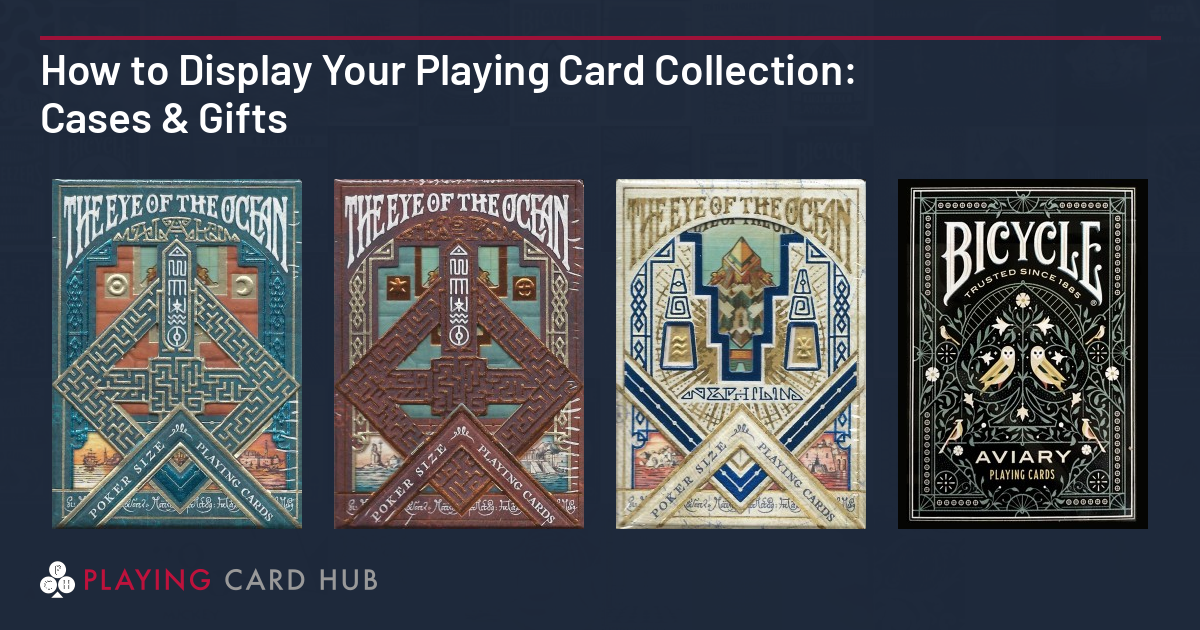
- A case plus a deck to go in it. Pair a display case with a deck from our best playing card decks to gift. A three-deck series like The Eye of the Ocean (Malakim, Gibborim and Nephilim) looks especially good side by side.
Tip: if you're not sure which decks they already own, check whether they have a public PlayingCardHub profile. Their collection and wishlist will tell you what they have and what they're hoping for.
 The Eye Of The Ocean - Malakim
Stockholm17
2024
4.3/5
 The Eye Of The Ocean - Gibborim
Stockholm17
2024
4/5
 The Eye Of The Ocean - Nephilim
Stockholm17
2024
4.2/5
 Aviary Black [Bicycle] (2021)
Bicycle
2021
4.4/5
Catalog what you display
A display shows your collection off. A catalog tells you what's in it. PlayingCardHub is a free deck database and collection tracker, so you can log every deck on your shelves, mark the ones you're still hunting for on your wishlist, and see your whole collection in one place. Create a free account to get started.
