In 1892, Russian magnate Alexander Zwenigorodskoi accomplished something truly preposterous. He spent an entire decade and over 120,000 rubles (equivalent to over $1 million today) simply to produce a catalog for his collection of Byzantine enamels.
This book, titled "The Zwenigorodskoi Collection Catalog," was limited to a mere 200 copies and was never offered for public sale. Zwenigorodskoi presented it as a diplomatic gift to royalty and dignitaries across Europe. A few years ago, Lotrek happened upon a physical copy of this remarkable volume, and its exquisitely intricate, 3D-embossed cover craftsmanship profoundly captivated him.
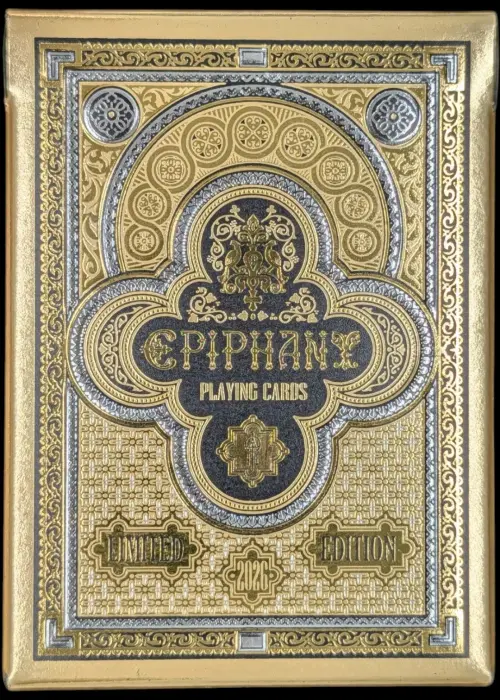
This profound impact became the genesis of EPIPHANY: Lotrek sought to condense the grandeur of details into a deck of playing cards.
While double-sided hot foil stamping is already considered high-end for playing cards, Epiphany's configuration is a bold experiment in triple-color overlapping foil.
To recreate the sacred luster found in Byzantine icons, Lotrek employed three distinct hot foil applications on both sides of every single card:
Semi-matte gold: Used to form the deep base color. Bright gold: Outlines intricate ornamental edges. Bright silver: Illuminates highlights within the imagery. These three metallic colors interweave on a bronze-hued metallic base stock, producing a sense of 3D depth reminiscent of ancient enamelware.
This process demands exceptionally high registration precision, with Lotrek even stating that it might be the most magnificent work he could ever print in his career.
This version has hand written "Gilded" on the bottom of tuck.