



A transformation deck is a deck where the pips (the hearts, diamonds, clubs and spades) are drawn into a larger picture, usually while staying in their normal positions. The idea took off in Germany in the early 1800s with J.F. Cotta's card almanacs, reached America in 1876, and produced one of the most famous American decks of all: the United States Playing Card Company's Vanity Fair No. 41 of 1895.
Pick up the five of diamonds from a transformation deck and you'll still count five red diamonds in the usual spots. But one might be a hat, another a kite, and the rest buttons on a coat. That small puzzle is the whole charm, and it's why these decks have been collected for two centuries.
What makes a deck a "transformation" deck
In a standard deck, pips are just symbols. In a transformation deck, the artist has to keep each pip where a player expects it and turn it into part of a scene. The Deutsches Spielkartenmuseum (the German Playing Card Museum) describes the number cards of the first great series as small paintings with the suit symbols integrated into them, so that "all the playing cards are transformed into pictures." That's where the German name Verwandlungskarten, and the English "transformation cards," come from.
A few things to know about the style:
- The number cards do the transforming. Court cards are often redrawn or made comical, but the pip cards are where the real puzzle is.
- Not every pip has to vanish. Some early American decks leave pips floating outside the picture. Albert Field, the collector who wrote the standard book on the subject, said of one 1876 deck that "the pips are by no means always integrated into the design."
- There's a looser cousin. PlayingCardHub tags both transformation decks and semi-transformation decks, so you can browse each style separately.
Where it started: Cotta's card almanacs (1804–1811)
The first complete, published transformation decks are usually credited to a publisher in Tübingen, Germany. According to the Deutsches Spielkartenmuseum's support association, the publisher Johann Friedrich Cotta, inspired by his conversations with Schiller and Goethe and by single cards drawn by Dietrich Wilhelm Soltau, published six card decks between 1804 and 1811. Each came with a small almanac booklet, a popular kind of pocket book for the new year with a quote or poem for each week. Fifty-two weeks, fifty-two cards: the fit was perfect.
The first, the Karten-Almanach für 1805, took its court cards from Schiller's play about Joan of Arc, Die Jungfrau von Orleans. A copy is digitized in the French national library's Gallica collection. The museum notes that Cotta's 240 number cards (40 a year across six years) became the model for many later decks, mostly from Germany and England.
You don't need a museum pass to see them. PlayingCardDecks.com reproduced the Cotta decks in 2020, printed by USPCC, and the standard edition of the first deck is in 39 PlayingCardHub collections as of November 9.
 Cotta's Almanac #1 Transformation Reproduction (Standard)
PlayingCardDecks.com
2020
4/5
Transformation decks come to America (1876)
The style crossed the Atlantic in a big way in 1876, the year the United States celebrated its centennial.
F.H. Lowerre's Eclipse Comic. The World of Playing Cards (WOPC), a long-running reference site for playing card history, calls Eclipse Comic, published in New York in 1876, the first transformation pack printed in the USA. It was also the first transformation pack anywhere to include a Joker. The humor is broad, and the pips don't always fit the pictures, but its place in history is secure. An original is held in the Albert Field playing card collection at Columbia University, and PlayingCardDecks.com used high-resolution images of it for a 2020 reproduction in red and blue, 500 decks each.
 Eclipse Comic (Red)
PlayingCardDecks.com
2020
3/5
Andrew Dougherty and the Centennial Exhibition. Andrew Dougherty was one of the biggest American card makers of the 19th century. WOPC shows a photograph of his stall at the Centennial International Exhibition in Philadelphia, which ran from May 10 to November 10, 1876. Dougherty's big innovation of the period wasn't a transformation deck, though. It was the "Triplicate," a miniature card printed in the top-left and bottom-right corners so players could read a hand of fanned cards. His patent for it, US 168,626, is dated October 11, 1875, and his Triplicate No. 18 deck dates to about 1876.
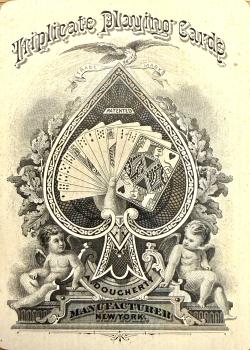 1876 Triplicate 18
A Dougherty
1876
5/5
Dougherty's own famous transformation deck came a few years later. The Murphy Varnish deck (about 1883) is a comical transformation deck that doubles as an advertisement for the Murphy Varnish company of Newark, New Jersey, with varnish salesmen and cans of varnish worked into the cards. Potter & Potter Auctions calls it "one of the best and most desirable American transformation decks," and it was chosen for the cover of the Hochman Encyclopedia of American Playing Cards. Home Run Games has since restored and reprinted it.
 The M.v. Card Standard (Murphy Varnish Restoration By Homerun Games)
Home Run Games
2015
5/5
By 1879 the style had gone upmarket too: Tiffany & Co. issued a Harlequin transformation deck that the Etteilla Foundation, a playing card archive, describes as a high-end product for the luxury market.
Vanity Fair No. 41 (1895): USPCC's classic
The United States Playing Card Company was formed in Cincinnati in 1894, and a year later it released Vanity Fair No. 41. It's the deck many collectors picture when they hear "transformation."
What's in the deck. Every number card is transformed into a scene, and the double-ended courts are redrawn as comic figures. WOPC and a Christie's auction listing describe them in detail: the king of spades smokes a pipe, the queen holds a spoon and the jack holds a shovel. The Joker is a winged devil with a pitchfork, and the Etteilla Foundation calls it an icon of American playing card history. The scenes show pets and animals, circus performers, baseball players, hunters, musicians and more. Like many decks of the 1890s, some cards also use racial and ethnic caricatures that were common at the time, and Potter & Potter's catalog notes this plainly.
Why it matters. The Etteilla Foundation describes Vanity Fair No. 41 as the first transformation deck made by USPCC, and notes that its comic courts reuse those of the Tiffany Harlequin deck. It's catalogued as T11 in the Hochman Encyclopedia of American Playing Cards, the standard reference collectors use for American decks.
How to recognize an original. Start with the ace of spades. On an 1895 deck, it shows Uncle Sam and Miss Liberty in full color and reads: "Vanity Fair No. 41, copyrighted 1895 by The United States Playing Card Company, Cincinnati, U.S.A." Original decks are poker size, and the copy Christie's sold had 52 cards plus the Joker and full gilt edges. More than one back design is known; the Christie's copy has a green back with four faces in caps inside a snowflake medallion and comic faces in the corners.
How to spot a reproduction. Two reproductions are common:
- Fournier, 1998. WOPC says it's the same as the original, except that it's bridge size, not poker size.
- PlayingCardDecks.com and Azured Ox, 2019. Printed by USPCC in red and green, 2,000 decks of each. To stop the cards being passed off as originals, the ace of spades reads just "Vanity," with "Fair" dropped, and the line at the bottom says "2019 REPRODUCTION BY PLAYINGCARDDECKS.COM & AZURED OX." The deck also adds a second Joker with the devil in green, a double-back card and an alternate nine of diamonds.
 Vanity Fair No 41
USPCC
1895
5/5
 Vanity No. 41 (Red)
PlayingCardDecks.com
2019
3/5
How collectors date and identify transformation decks
Antique transformation decks are rare enough that most of what turns up is a reproduction. A few checks will tell you a lot:
- Read the ace of spades. Makers put their name, deck number and often a copyright year here, and modern reproductions usually add a reproduction notice.
- Measure a card. Poker size versus bridge size is the quickest way to tell the original Vanity Fair from the Fournier reprint.
- Look at the corners. American corner indices date from the 1870s (Dougherty's Triplicates are an early example), so a deck's indices help place it in time.
- Count the cards. A complete 1890s American deck is usually 52 cards plus a Joker. Extra Jokers, ad cards or "gaff" cards often point to a modern deck.
- Check the box and seal. Many reproductions come with replica tax stamps and boxes, so treat the box as a clue, not proof.
- Look it up. Auction houses and dealers cite Hochman numbers (T5 for Murphy Varnish, T11 for Vanity Fair), and matching a deck to its catalog entry is the best confirmation you'll get.
Modern transformation decks on PlayingCardHub
Transformation decks never went away, and plenty of today's designers have tried the challenge. A few verified examples from the PlayingCardHub database:
- Royal Mischief Transformation (Deviant Moon, 2019). Patrick Valenza's sepia-toned deck, published by U.S. Games Systems, hides its suit marks in a cast of devilish children and ghouls. Its description says it was "inspired by vintage transformational decks."
- Suits of Life (Plastic Pen Art, 2026). Stefan Große Halbuer's isometric illustration deck, printed by WJPC, gives each suit a theme (love, nostalgia, food and nature) and pairs transformation number cards with full-length courts.
- Cotta's Almanac reproductions (PlayingCardDecks.com, 2020). Six decks that bring the original 1800s series back to the table.
 Royal Mischief Transformation
Deviant Moon
2019
4.5/5
 Suits Of Life
Plastic Pen Art
2026
For the full list, browse the transformation theme or look up decks from 1895 and 1876.
Track your transformation decks
Whether you own an antique Vanity Fair or a shelf of modern reprints, PlayingCardHub is a free deck database and collection tracker. Log the decks you have, add the ones you're hunting for to your wishlist, and see which transformation decks other collectors own. Create a free account to get started.
FAQs
What is a transformation deck of playing cards? It's a deck where the suit symbols on the number cards are drawn into a picture, usually while staying in their normal positions, so the card is still playable but each pip becomes part of a scene.
What was the first transformation deck? The first complete published transformation decks are usually credited to J.F. Cotta of Tübingen, who published six card almanacs between 1804 and 1811. In the US, WOPC credits F.H. Lowerre's Eclipse Comic (1876) as the first transformation pack printed in America and the first to include a Joker.
What is the Vanity Fair No. 41 deck? It's a transformation deck the United States Playing Card Company published in Cincinnati in 1895, with transformed number cards, comic courts and a winged devil Joker. It's catalogued as T11 in the Hochman Encyclopedia of American Playing Cards.
How can I tell if my Vanity Fair deck is an original? Check the ace of spades and the card size. The 1895 original is poker size and its ace reads "Vanity Fair No. 41... Cincinnati, U.S.A." The 1998 Fournier reprint is bridge size, and the 2019 reprint's ace reads "Vanity" with a reproduction notice.
Are antique transformation decks valuable? Some are. For example, Potter & Potter estimated an 1895 Vanity Fair No. 41 deck at $300 to $500 and a Murphy Varnish deck at $3,000 to $5,000 in its February 2026 sale. Estimates aren't appraisals, and condition, completeness and the original box all matter, so get an expert opinion before you trade or sell a rare deck.
Did Andrew Dougherty make transformation decks? Yes. His best-known one is the Murphy Varnish advertising deck from about 1883. At the 1876 Centennial Exhibition, his big news was the Triplicate corner index rather than a transformation deck.
Sources
- Förderverein Deutsches Spielkartenmuseum, "Transformationskarten aus unserer Nachbarstadt" (Cotta, six decks 1804–1811, almanacs, Soltau, Verwandlungskarten, influence): https://www.nussbaum.de/entdecken/news/transformationskarten-aus-unserer-nachbarstadt-3682825
- PlayingCardDecks.com, "The Famous J.G. Cotta Transformation Decks" (Cotta credited with the first published complete deck; 1810 issued only as book illustrations): https://playingcarddecks.com/blogs/all-in/the-famous-j-g-cotta-transformation-decks
- WOPC, Ken Lodge, "Andrew Dougherty" (one of the biggest American card makers): https://www.wopc.co.uk/members/ken-lodge/andrew-dougherty
- Gallica (BnF), Karten-Almanach für 1805: https://gallica.bnf.fr/ark:/12148/btv1b10336510s
- WOPC, Eclipse Comic playing cards (reproduction) (first US transformation pack, first with a Joker, Field quote, Columbia/Albert Field collection, 2020 reproduction): https://www.wopc.co.uk/usa/eclipse-comic-playing-cards-repro
- WOPC, Andrew Dougherty 1848–1930 (Centennial Exhibition stall and dates, Triplicates): https://www.wopc.co.uk/usa/dougherty/andrew-dougherty-1848-1930
- WOPC, Triplicate No. 18 (patent 168,626, dated Oct 11, 1875): https://www.wopc.co.uk/usa/dougherty/triplicate-18
- Google Patents, US 168,626: https://patents.google.com/patent/US168626A/en
- WOPC, Murphy Varnish pack (1883, Newark, Hochman cover, reproduction): https://www.wopc.co.uk/transformation/murphy-varnish-pack
- Potter & Potter, A. Dougherty "Murphy Varnish" Transformation Playing Cards, Feb 19, 2026, lot 26 (estimate, Hochman T5): https://auction.potterauctions.com/online-auctions/potter-potter/a-dougherty-murphy-varnish-transformation-playing-cards-8715970
- WOPC, Vanity Fair (1895 description, Fournier 1998 and 2019 reproductions): https://www.wopc.co.uk/usa/the-united-states-playing-card-company/vanity-fair
- Christie's, Vanity Fair Playing Cards (No. 41), 1895 (52 + Joker, gilt edges, ace text, back design, T11): https://www.christies.com/en/lot/lot-4740356
- Potter & Potter, USPCC "Vanity Fair No. 41" Transformation Playing Cards, Feb 19, 2026, lot 28 (subjects, stereotypes, estimate): https://auction.potterauctions.com/online-auctions/potter-potter/united-states-playing-card-co-vanity-fair-no-41-transfo-8715972
- Etteilla Foundation, Vanity Fair No 41 and Transformation Decks (first USPCC transformation deck, Tiffany Harlequin courts, 1879 Harlequin, devil Joker): https://new.etteilla.org/en/decks/vanity-fair-41/ and https://new.etteilla.org/en/archetypes/transformation-decks/
- WOPC, The United States Playing Card Company (founded 1894): https://www.wopc.co.uk/usa/the-united-states-playing-card-company/
- U.S. Games Systems, Royal Mischief Transformation Playing Cards: https://www.usgamesinc.com/royal-mischief-transformation-playing-cards.html
- PlayingCardHub deck pages: Cotta's Almanac #1 (Standard), Eclipse Comic (Red), 1876 Triplicate 18, The M.V. Card (Murphy Varnish restoration), Vanity Fair No 41, Vanity No. 41 (Red), Royal Mischief Transformation, Suits of Life.
