


Ask ten card players for the best playing card brand and you'll get ten answers, and most of them will be right. A poker host wants a deck that survives a long night. A magician wants a familiar back that nobody questions. A cardist wants a deck that fans evenly and springs cleanly. A collector wants art, tuck boxes and print runs worth talking about.
So instead of crowning one winner, this guide breaks the field into the brands that lead each category. It draws on what we see across PlayingCardHub's database of roughly 32,000 decks: which companies have the deepest catalogs, which decks show up again and again in collections, and which names collectors keep searching for.
How we judge a playing card brand
Before the list, here's what actually separates a great brand from a forgettable one:
- Card stock and finish. How the cards shuffle, fan and hold up after a few hundred hands. Our guide to playing card finishes and stocks covers this in depth.
- Consistency. A good brand feels the same from deck to deck and print run to print run.
- Catalog depth. Brands with large, varied catalogs give collectors more to chase.
- Design. Back designs, court cards, pips and tuck boxes.
- Collector interest. How often a brand's decks end up in real collections.
Bicycle: the default deck for a reason
If you've played cards at a kitchen table in the US, you've probably held a Bicycle deck. The Rider Back design is one of the most recognized card backs anywhere, and the brand's air-cushion finish is what many players think a deck "should" feel like.
What makes Bicycle interesting to collectors is how far the brand reaches beyond the standard red and blue deck. Over the years it has carried a huge number of themed, licensed and custom designs, many printed for independent creators. That makes it one of the largest catalogs on PlayingCardHub.
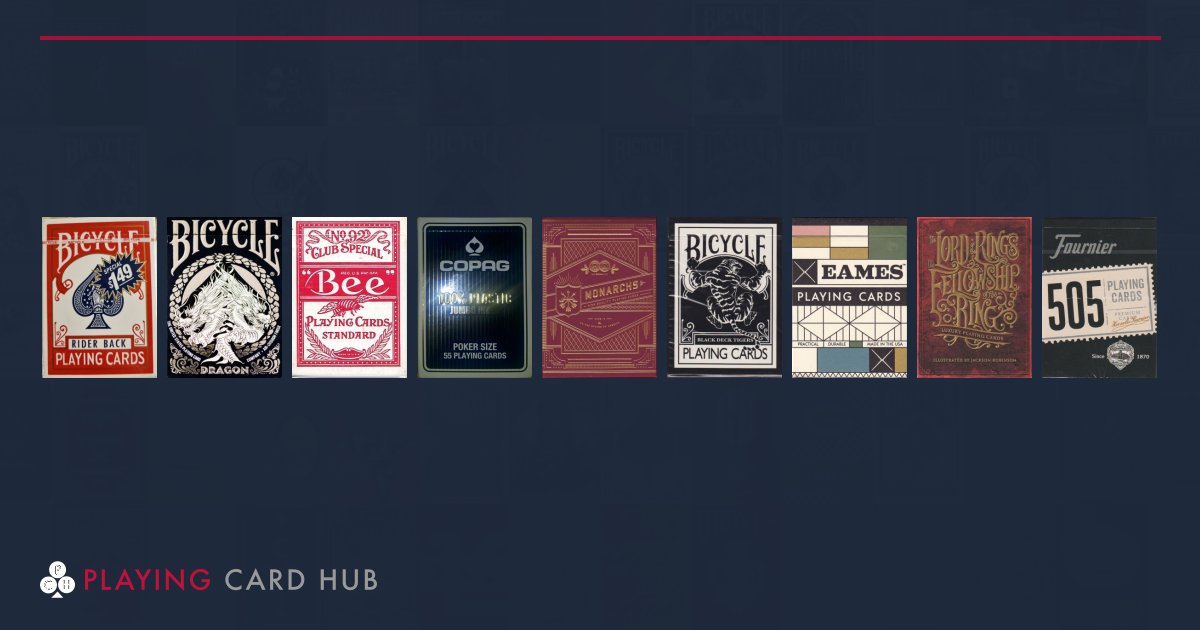
 Rider Back [Bicycle]
USPCC
 Dragon [Bicycle]
USPCC
2018
3/5
Best for: everyday games, learning magic, and collectors who like variety.
Bee: the casino standard
Bee is the deck many people picture from a casino table. Its trademark diamond-pattern back runs to the edge of the card with no white border, and the stock has a slightly different feel from Bicycle, which a lot of players prefer for dealing.
Bee is a great pick for poker nights and anyone who wants a more "pro table" feel at home. For collectors, casino-branded Bee decks are a whole hobby on their own.
 Bee Club Special Standard Red
USPCC
1998
Best for: poker, blackjack and casino-style home games.
KEM and Copag: plastic durability
If durability is the only thing that matters, fully plastic cards win. KEM and Copag are the names most associated with plastic cards for serious poker. Plastic decks can be washed, resist bending and last far longer than paper under heavy play.
The tradeoff is feel. Plastic decks shuffle and fan differently, and they're not the first choice for magic or cardistry. But for a weekly game, a plastic deck often pays for itself.
 Copag 100% Plastic Jumbo Index Blue
Copag
5/5
Best for: regular poker games, outdoor play and anyone tired of replacing paper decks.
theory11: luxury and licensed design
theory11 changed what a lot of people expect from a premium deck. Its decks lean into luxury packaging, detailed embossing and foil on the tuck box, and a run of high-profile licensed designs. For many people, a theory11 deck is the first deck they keep instead of using.
 Monarchs Red V1
Theory 11
2013
4.5/5
Best for: gifts, display shelves and collectors who love premium packaging.
Ellusionist: magic and cardistry roots
Ellusionist grew up alongside the online magic community, and its decks tend to show it. Bold, dark designs, decks made with performers in mind, and a long catalog of releases that collectors still track.
 Black Tigers V1 (808) [Bicycle]
Ellusionist
4/5
Best for: magicians and collectors drawn to bold, modern design.
Art of Play and Dan and Dave: design-led decks
Art of Play, founded by Dan and Dave, approaches playing cards almost like a design studio would. Clean art, unusual collaborations and a strong eye for what makes a deck feel like an object, not just a game piece. Cardists in particular have followed Dan and Dave's work for years.
 Eames Kite 3Rd Edition
Art of Play
2023
4/5
Best for: cardistry and design-minded collectors.
Kings Wild Project: illustrated, story-driven decks
Kings Wild Project, led by designer Jackson Robinson, is known for highly illustrated decks with custom courts and rich historical or literary themes. These are decks you study card by card.
 The Lord Of The Rings: The Fellowship Of The Ring (Standard)
Kings Wild Project
2022
4.7/5
Best for: collectors who care about illustration and theme.
 Fournier 505 Blue
Fournier
2/5
European makers: Fournier, Modiano and Cartamundi
The best playing card brands aren't all American. Fournier is a long-established Spanish maker, Modiano is Italian, and Cartamundi is one of the largest card manufacturers in the world, based in Belgium. These companies print classic regional patterns, games and custom decks, and many collectors find their stock and finishes a refreshing change from US-printed decks.
Best for: collectors interested in regional patterns and a different handling feel.
Who prints the decks?
One thing that surprises new collectors: the name on the box often isn't the printer. Many custom decks from independent studios are printed by the United States Playing Card Company, Cartamundi, or other large printers. That's why two decks from different "brands" can feel almost identical, and two decks from the same brand can feel quite different. Every deck page on PlayingCardHub lists the publisher, and where we know it, the printer.
How to choose the right brand for you
- For game nights: Bicycle or Bee for paper, KEM or Copag if you want them to last.
- For magic: a familiar back like Bicycle, plus a premium deck for performances.
- For cardistry: design-led decks with a thin, snappy stock.
- For gifts: luxury brands with great packaging.
- For collecting: pick a lane, like one studio, one illustrator or one theme, and use your PlayingCardHub collection to track it.
Our take
There isn't one best playing card brand. There's a best brand for the way you use cards. Start with a reliable classic, add a premium deck when you find one you love, and let your collection grow from there. Browse the playing card brands and companies directory on PlayingCardHub to see full catalogs and find the brands that fit your taste.
FAQ
Q: What is the best playing card brand? A: It depends on use. Bicycle and Bee are the classic choices for everyday play, KEM and Copag lead for plastic durability, and studios like theory11, Ellusionist, Art of Play and Kings Wild Project lead for design and collectibility.
Q: Are Bicycle and Bee made by the same company? A: Both brands are associated with the United States Playing Card Company. They have different backs, borders and feel, which is why players often have a strong preference.
Q: What is the most durable playing card brand? A: Fully plastic decks from KEM and Copag are generally the most durable. They resist bending and can be cleaned.
Q: What brand do magicians use? A: Many magicians use Bicycle decks because the back design is familiar to audiences. Ellusionist and theory11 decks are also popular with performers.
Q: Which playing card brand is best for collecting? A: Collectors often focus on independent studios with limited print runs and strong art, such as Kings Wild Project, Art of Play, theory11 and Ellusionist. PlayingCardHub lets you track any brand's catalog in your collection.


